From Gizmodo: Why We Need to Reach the Stars (and we will) "...space exploration is the most epic and most important adventure Humanity has ever embarked upon. When we travel to space we are opening the way to the preservation of Humanity. We are trying to contact other civilizations. We are trying to answer the biggest questions of them all: Who are we? Why are we here? How did we get here? Are we alone in this rock we call Earth?"
From Earth To Moon Redux: How The Next Moonshot Will Happen "May 2019: Our scheduled return to the moon. There's plenty of laboring to be done on the Constellation Program before then, but the foundation is set. Here's how you—as an astronaut—would experience the mission"
The Charms of Soyuz: Blasting Off In a Crazy Russian Rocket "Yesterday, I wrote about what launching aboard a Space Shuttle is like. This time, let's consider the Russian Soyuz rocket and spacecraft. Why? Isn't a rocket a rocket? Is it really that different? Yes and no, no and yes. They both get astronauts into space in around nine minutes. But, they are very different." Pre-Launch Jitters and Then... Liftoff "What's it like to go through a launch? How does it feel? Are you able to sleep the night before? Do you get scared? What do you eat before?"
What is it?: A spacecraft design currently under development by NASA. Each Orion spacecraft will carry a crew of four (for ISS missions) to six astronauts (for Lunar missions), and will be launched by the Ares I (see previous Space Tech of the Week). Both Orion and Ares I are elements of NASA's Project Constellation, which plans to send human explorers back to the Moon by 2020, and then onward to Mars and other destinations in the Solar System.
"Orion will launch from Launch Complex 39 at Kennedy Space Center, the same launch complex that currently launches the Space Shuttle." The first Orion flight to the ISS is currently scheduled for 2015, but delays are expected. If commercial orbital transportation services (by Space X with its Dragon capsule) are unavailable, Orion will handle logistic flights to the Station.
"The Orion Crew and Service Module (CSM) stack consists of two main parts: a conical Crew Module (CM), and a cylindrical Service Module (SM) holding the spacecraft's propulsion system and expendable supplies. Both are based substantially on the Apollo Command and Service Modules (Apollo CSM) flown between 1967 and 1975, but include advances derived from the Space Shuttle program."
During the early phases of its development Orion was going to have the capability land on land (like the Soyuz) as well as on water (like Apollo, Gemini, and Mercury). Since then, due to weight issues, water landings have become the only method of recovery for this spacecraft.
"Another feature will be the partial reusability of the Orion CM. NASA aims to reuse each craft for up to ten flights." "Both the CM and SM will be constructed of the aluminium lithium (Al/Li) alloy currently used on the Shuttle's External Tank, and the Delta IV and Atlas V rockets. This alloy is as strong as the Shuttle Orbiter's aircraft aluminium skin, but will make the spacecraft lighter than both its Apollo and Shuttle predecessors."
"Like its Apollo predecessor, the Orion Service Module (SM) has a rough cylindrical shape, but unlike its Apollo predecessor, the new Orion SM will be larger in diameter, shorter, and lighter. It too will be constructed from the same Al-Li alloy as the Orion CM, and will feature a pair of deployable circular solar panels, similar in design to the solar panels on the Mars Phoenix lander, eliminating the need to carry fuel cells and the associated hardware—mainly tanks containing liquid hydrogen [LH2]—needed for their operation. The spacecraft's main propulsion system is an Aerojet AJ-10 rocket engine, derived from the second stage of the Delta II rocket, powered by hypergolic fuels, that are kept in helium pressured fuel cells. "
"NASA has sketched out the development timetable for its return-to-the-Moon Constellation programme's Altair lunar lander, aiming towards a long-term target of an unmanned June 2018 in-orbit propulsion test in preparation for a manned Moon mission in 2020."
What is it?: "Ares I is the crew launch vehicle being developed by NASA as a component of Project Constellation. NASA plans to use Ares I to launch Orion, the spacecraft being designed for NASA human spaceflight missions after the Space Shuttle is retired in 2010."
The Constellation program, which Ares I is a part of, was begun as an answer to President George W. Bush's Vision for Space Exploration which challenged the agency to return people to the Moon and on to Mars. The official goal of the program is "gaining significant experience in operating away from Earth's environment, developing technologies needed for opening the space frontier and conducting fundamental science."
During the Apollo program one launch vehicle (Saturn V) was used to send both the crew and cargo to the moon, instead the Constellation program will use two vehicles to accomplish the same task (Ares I and Ares V). Ares I will carry the crew in the Orion spacecraft which will later dock in space with the Altair lunar lander (launched onboard an Ares V rocket) and then proceed to the moon.
Ares I will also launch the Orion spacecraft in order to send astronauts to the International Space Station after the Space Shuttle is retired in 2010.
Ares I was designed to use previously proven NASA technologies and so as a result it uses technology from both the Space Shuttle program and the Saturn rocket program.
The first stage of the vehicle is a solid fuel rocket that is derived from the current Space Shuttle Solid Rocket Boosters (SRB). "Compared with the current SRB, which has four segments, the most notable difference is the addition of a fifth segment. This fifth segment will enable the Ares I to produce more thrust and burn longer." The first stage for Ares I will be reusable and after flight it will crash down into the Atlantic ocean (by parachute), be retrieved, briefly serviced at Kennedy Space Center,Fl, then sent to Utah for it to be fully refurbished, and then finally it will then be sent back to Kennedy Space Center for integration into a new Ares I.
The upper stage of the vehicle will be propelled by one J-2X liquid fueled rocket engine. This engine is derived from the J-2 engine used in the Saturn program in the 1960s and 70s. Unlike the first stage, the upper stage will not be reusable. New upper stages will need to be built for every mission. This manufacturing will be done at the NASA Michoud Assembly Facility in Louisiana. It will then be transported on a barge across the Gulf of Mexico to be integrated with the rest of the vehicle at Kennedy Space Center.
"Multiple delays in the Ares I development schedule due to budgetary pressures and unforeseen engineering and technical difficulties continue to increase the gap between the end of the Space Shuttle program and the first operational flight of Ares I. As of late 2007, the first operational Ares I flight is scheduled for late 2015, a full five years after the last Shuttle flight"
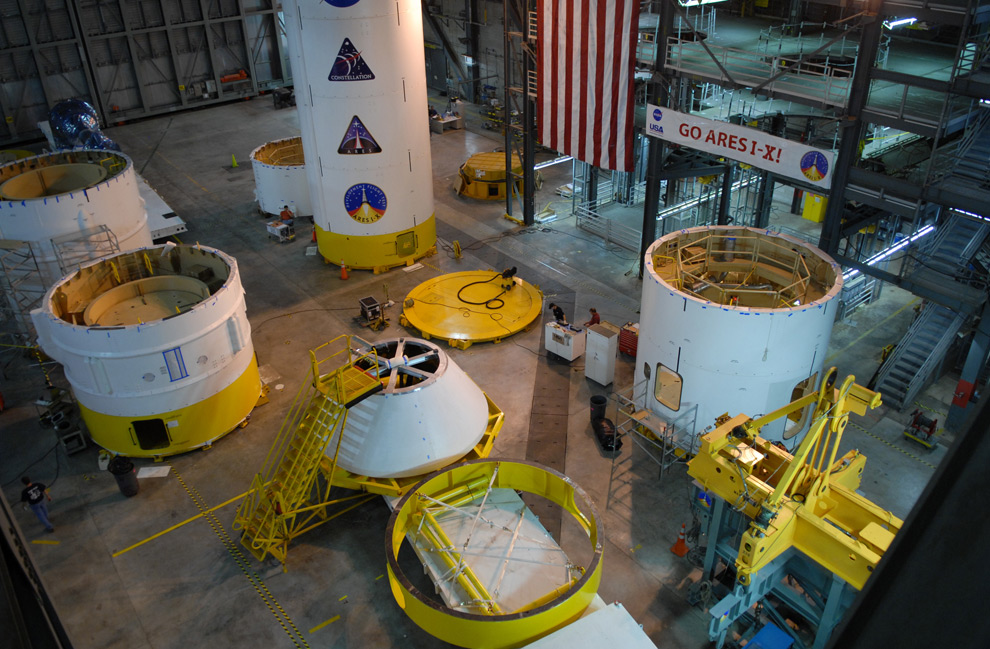
A test flight vehicle (named Ares I-X) which will be similar in shape, weight, and size to Ares I will be launched from Kennedy Space Center in Summer 2009.