My looooong response to ABC News Question: Is American's Space Program Worth the Money?
Funding AND supporting NASA can help meet 2 out of the 5 main agenda items listed on President Obama's change.gov transition web page:
1) Revitalizing the Economy and 5) Renewing American Global Leadership
We can not be left behind in space after holding such a substantial lead for decades. We (as a country) must continue to push new frontiers and when we have paved the way we should pass it on to private companies who will continue the work and create new jobs and industries. Companies like Scaled Composites, Virgin Galactic, Bigelow Aerospace, and SpaceX are beginning to "settle" on that frontier that NASA first reached in the 1960s. Earth orbit's future is now in the hands of these pioneers.
Now NASA must push beyond Earth orbit and continue our expansion into space. We need to go to the moon and beyond. India and China both have solid plans to send men to the moon by 2020 and the Europeans and Russians have their own goals in regards to the moon as well. In the 1960s and 70s we sent men to the moon and it seemed that there was nothing that could hold back American ingenuity and innovation. The world looked at us in awe. We must not lose this global leadership.
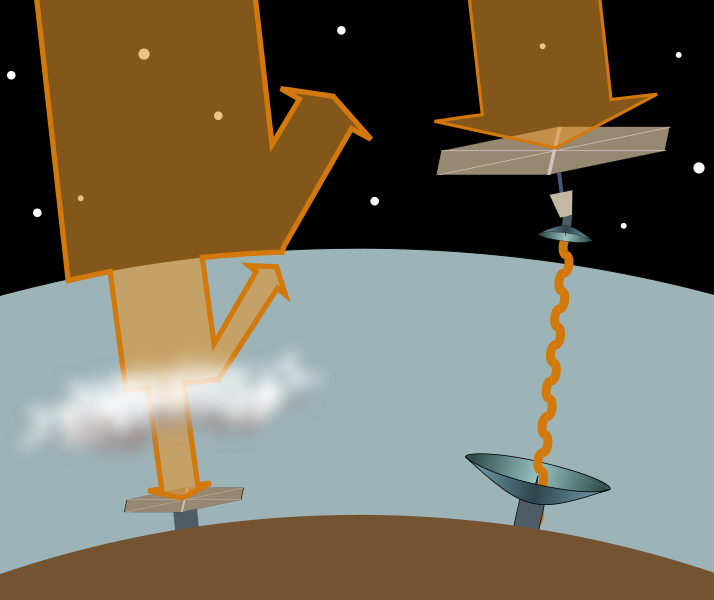
Sending people to the moon would help revitalize our economy because it will create many new jobs to help support this undertaking. We will need all types of people to help build, design, and manage a manned space exploration program to the moon. In addition to that, the space infrastructure that would be created to set up permanent moon bases should also help in the reduction of costs to reach Earth orbit. Lowered costs for reaching Earth orbit can lead to cost savings in the communications industry (which in turn lead to lower costs for all of us). In addition to that, low costs can also lead to the creation of 100% green power sources like Space Solar Power Satellites (Here's a video on that: http://www.youtube.com/watch?v=YiU9MibyBJ0 and the extensive wikipedia article: http://en.wikipedia.org/wiki/Solar_power_satellite). All that leads to even more economic revitalization.
Also, if you look at it from a longer term perspective, when moon bases become more common (as travel to Earth orbit is becoming today) private corporations will start to pick up where NASA has left off. Why should private corporations go to the moon? Well the moon seems to have huge amounts of Helium-3 under its surface, and on Earth this isotope is very rare. It is hoped that one day (we aren't there yet) this will be used as a fusion power source. How useful can He-3 be for life here on Earth? 25 tons of it (which could be carried back on just one space round trip) can power the entire U.S. for one year. With this amount we could replace all fuels that we pay for essentially making the helium 3 worth about $3 billion per ton. In my opinion He-3 is the reason why so many other countries are in such a rush to get to the moon (see more info below).
In terms of inspiration I can't think of anything more inspiring than continually trying to do the impossible. As JFK once said:
"But why, some say, the moon? Why choose this as our goal? And they may well ask why climb the highest mountain? Why, 35 years ago, fly the Atlantic? Why does Rice play Texas? We choose to go to the moon. We choose to go to the moon in this decade and do the other things, not because they are easy, but because they are hard, because that goal will serve to organize and measure the best of our energies and skills, because that challenge is one that we are willing to accept, one we are unwilling to postpone, and one which we intend to win, and the others, too. "
In this country we constantly complain about the state of our education and our lack of a new generation of scientists and engineers, but why should our students strive to achieve these careers? Yes, we have many challenges in medicine and energy, and I agree that these are very important and they can be inspiring to many, but exploration and new discoveries are what (in my opinion) have pushed the boundaries of human imagination. You don't see many movies or read many books about the exciting adventures of engineers developing new energy sources, do you? In ancient times people looked at far away mountains and oceans and wondered what was beyond. They wondered and then they worked to find out and in the process pushed mankind forward. If you wanted to know what their goal was they just needed to point to that nearest mountaintop or to the ocean. Today, we can look to the sky and point to the moon.
UPDATE 4/14/09:
Some valuable (official) resources for those of you writing research papers on why we should fund NASA.
- NASA @ Home & City: NASA Website that shows how space exploration impacts your daily life
- NASA Innovative Partnerships Program: Examples of technologies developed by NASA that were successfully transferred into the commercial market.
- NASA Spin-offs: Even more examples of technologies invented by NASA that have now been successfully commercialized.
- NASA Tech Briefs: Magazine of technologies NASA is making available for commercialization.
- Race to the Moon for Nuclear Fuel: Wired Magazine Article on Helium 3 on the Moon.
- Researchers and space enthusiasts see helium-3 as the perfect fuel source: Space.com article on Helium-3
- Harvest the Sun - From Space: NY Times Op-Ed on Solar Power Satellites
- PG&E signs deal for solar power from satellites: Mercury News article on a new deal in works to provide power for California
- Space Solar Power: Limitless Clean Energy from Space: National Space Society article with lots of information and lots of sources for information on Space Solar Power.